Off-Grid Caravan Power: Your Ultimate Solar & Battery Guide for the Big Lap
Master your off-grid caravan power with this essential solar and battery guide for travelling Australia. Free calculator included!
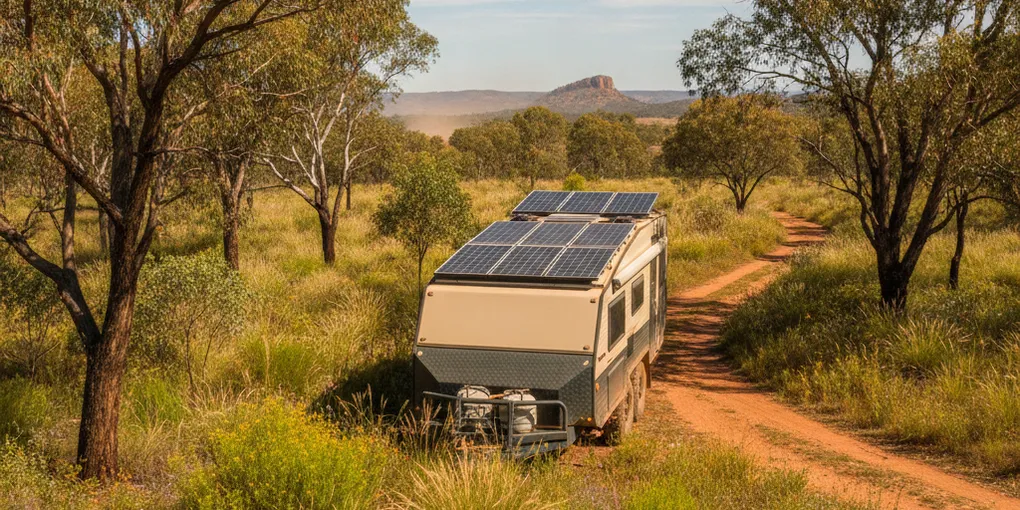
Off-Grid Caravan Power: How Much Solar and Battery Do I Really Need for the Big Lap?
Figuring out your off-grid caravan power needs is crucial for travelling Australia. You’ll need enough solar panels to replenish your batteries, and enough battery capacity to get you through the night and cloudy days.
The dream of freedom on the open road, powered entirely by the sun, is what the Big Lap is all about. But that dream can quickly turn into a nightmare if your caravan’s power system isn’t up to scratch. For many travelling Australia, particularly those venturing off-grid, understanding solar and battery systems is no longer a technical mystery – it’s a vital skill. This guide will break down everything you need to know, from calculating your energy draw to choosing the right gear.
Why Off-Grid Power Matters for Australian Travellers
Imagine waking up to the sound of waves, far from the nearest powered campsite, and knowing your fridge is humming along, your lights are ready, and your devices are charging. That’s the freedom off-grid power offers. No more hunting for powered sites, no more paying hefty fees. Just pure, unadulterated adventure. However, this freedom comes with responsibility. A well-planned power system is the cornerstone of a successful off-grid experience.
Step 1: Calculate Your Daily Energy Draw (The “What Uses Power?”)
Before you even think about solar panels or batteries, you need to know how much power you’re actually using. This is where most people get it wrong, overestimating or underestimating their needs, leading to either an undersized, frustrating system or an unnecessarily expensive one.
List everything in your caravan that uses electricity. Go through it systematically:
- Appliances: Fridge, freezer, microwave, coffee machine, kettle (if electric), TV, laptop, phone chargers, cameras, portable fan, water pump, internal lights, external lights.
- “Always On” Devices: Some devices, like certain monitors or the fridge’s control panel, might draw a small amount of power constantly.
- Seasonal Items: Consider things you might only use during certain times of the year, like a small heater or a specific appliance.
Now, find the wattage of each item. This is usually printed on a label on the appliance itself. Then, estimate how many hours per day you’ll use each item.
The Formula: Wattage (W) x Hours of Use (h) = Watt-hours (Wh) per day per item.
Sum up the Watt-hours for all your devices to get your total daily energy consumption in Watt-hours (Wh).
Pro Tip: It’s always better to overestimate slightly. An extra 10-20% can save you a lot of headaches during those unexpected cloudy spells or longer-than-planned stays away from power.
Step 2: The Lap Club Power Calculator – Your Secret Weapon
Trying to do these calculations manually can be a bit of a chore, especially when you’re trying to get your head around the complexities of battery types, solar yields, and inverter efficiencies. This is precisely why we developed The Lap Club Power Calculator at https://lapclub.com.au/power.
This free, user-friendly tool is designed specifically for travellers like you. Simply input your appliances, their wattage, and daily usage, and it will:
- Estimate your total daily energy draw (in Amp-hours and Watt-hours).
- Help you understand the impact of different appliances.
- Give you a solid starting point for sizing your solar and battery system.
This calculator is an invaluable resource for anyone planning their off-grid setup, ensuring you have a realistic understanding of your power needs before you invest. Check it out before you make any purchasing decisions!
Step 3: Sizing Your Battery Bank (The “How Much Storage Do I Need?”)
Your battery bank is the heart of your off-grid system. It stores the energy generated by your solar panels and powers your caravan when the sun isn’t shining.
Key Considerations for Battery Sizing:
- Depth of Discharge (DoD): This refers to how much of your battery’s capacity you can safely use without damaging it. Lead-acid batteries (like AGM and Gel) typically have a DoD of 50%, meaning you only use half their rated capacity. Lithium-ion batteries (LiFePO4) are much better, often allowing for 80-90% DoD. This significantly impacts how large a battery you need.
- Days of Autonomy: How many days do you want to be able to run your system without any solar input (e.g., during prolonged bad weather)? Most travellers aim for 2-3 days.
The Calculation (Simplified):
(Total Daily Energy Draw (Wh) x Days of Autonomy) / Maximum Depth of Discharge (%) = Required Battery Capacity (Wh)
To convert Watt-hours to Amp-hours (Ah), which is how batteries are usually rated:
Required Battery Capacity (Wh) / Battery Voltage (e.g., 12V or 24V) = Required Battery Capacity (Ah)
Example: If your daily draw is 1500Wh and you want 2 days of autonomy with LiFePO4 batteries (90% DoD at 12V):
(1500Wh x 2 days) / 0.90 = 3333Wh required capacity
3333Wh / 12V = 278Ah required capacity
So, you’d be looking for a battery bank of around 300Ah (it’s good practice to round up).
Battery Types: What’s Right for Your Trip?
| Battery Type | Pros | Cons | Best For |
|---|---|---|---|
| AGM/Gel | Cheaper upfront, widely available, maintenance-free (sealed). | Heavier, shorter lifespan, lower DoD (50%), slower charging, sensitive to overcharging. | Budget-conscious travellers, short trips, limited power needs. |
| Lithium-ion (LiFePO4) | Lightweight, long lifespan, high DoD (80-90%), faster charging, more efficient. | Higher upfront cost, can be sensitive to extreme cold (though many have built-in heating). | Serious off-grid travellers, those wanting reliability and longevity. |
For most serious Big Lappers, LiFePO4 (Lithium Iron Phosphate) batteries are the clear winner due to their longevity, efficiency, and lighter weight. While the initial investment is higher, the total cost of ownership over several years is often much lower than replacing lead-acid batteries multiple times.
Step 4: Sizing Your Solar Array (The “How Much Solar Power Do I Need?”)
Your solar panels are responsible for replenishing your battery bank. The size of your array depends on your daily energy draw, the average hours of peak sunlight you expect, and the efficiency of your panels and charging system.
Key Factors:
- Peak Sun Hours: This isn’t just the number of daylight hours. It’s the equivalent number of hours where the sun’s intensity is at its maximum (around 1000 W/m²). This varies significantly across Australia and by season. A good average for much of inland Australia is 5-6 peak sun hours per day, but coastal areas or southern regions in winter can be significantly less.
- Panel Efficiency: Modern panels are more efficient, meaning they generate more power per square metre.
- Charge Controller Efficiency: This device regulates the power from your panels to your batteries. MPPT (Maximum Power Point Tracking) controllers are more efficient than PWM (Pulse Width Modulation) controllers.
- Shading: Even partial shading can drastically reduce a panel’s output.
The Calculation (Simplified):
Total Daily Energy Draw (Wh) / Peak Sun Hours (h) = Required Solar Array Wattage (W)
Example: If your daily draw is 1500Wh and you expect 5 peak sun hours:
1500Wh / 5h = 300W required solar array
Again, it’s wise to add a buffer of 20-30% to account for less-than-ideal conditions, panel degradation over time, and inefficiencies. So, for a 300W requirement, you might aim for 360-400W of solar panels.
Solar Panel Types
- Monocrystalline: Generally the most efficient and best performers in lower light conditions, but also the most expensive. They have a uniform dark colour.
- Polycrystalline: Slightly less efficient and cheaper than monocrystalline. They often have a mottled blue appearance.
- Flexible Panels: Lightweight and can be mounted on curved surfaces. However, they are typically less efficient and can have a shorter lifespan and higher failure rate.
Other Essential Components
- Solar Charge Controller: Essential to protect your batteries from overcharging and damage. MPPT controllers are highly recommended for their efficiency.
- Inverter: If you have 240V appliances (like a microwave or kettle), you’ll need an inverter to convert the DC power from your batteries into AC power. Size your inverter based on the highest single wattage appliance you’ll run simultaneously, plus a buffer. Pure sine wave inverters are recommended for sensitive electronics.
- Wiring and Fuses: Don’t skimp here! Use the correct gauge wiring to prevent voltage drop and ensure safety. Fuses and circuit breakers are crucial safety devices.
- Battery Monitor: A good battery monitor is invaluable for tracking your battery’s state of charge, voltage, and current.
Tips for Maximising Your Off-Grid Power
- Efficient Appliances: Invest in 12V appliances designed for caravans where possible. They are often more efficient than their 240V counterparts running through an inverter.
- Manage Your Usage: Be mindful of your power consumption. Turn off lights when not needed, use laptops instead of TVs for some tasks, and consider a portable gas stove or BBQ for cooking instead of an electric appliance.
- Panel Placement: Position your panels to minimise shading. Clean them regularly as dust and grime can significantly reduce output. If you have tiltable panels, adjust them throughout the day to face the sun.
- Regular Maintenance: Check connections, clean panels, and monitor your battery health.
Getting Started with The Lap Club
Planning and optimising your off-grid power system is a critical part of preparing for the Big Lap. The community at The Lap Club (https://lapclub.com.au) is full of experienced travellers who share their knowledge and tips. We encourage you to explore the resources and join the conversation.
Remember, getting your power system right is about balancing your needs with your budget and desired level of freedom. It’s a learning curve, but with the right information and tools, you’ll be enjoying your off-grid adventures with confidence.
We’re constantly working to bring you more tools and resources to make your travelling life easier. Keep an eye on our website and join the waitlist for our upcoming app at https://lapclub.com.au – it’s going to be a game-changer for Big Lap travellers! You can also find more helpful articles on our blog at https://lapclub.com.au/blog.
Frequently Asked Questions (FAQ)
How do I calculate my caravan’s daily power usage?
You need to list all your electrical devices, find their wattage, and estimate how many hours per day you use them. Multiply wattage by hours to get Watt-hours (Wh) for each device, then sum them up for your total daily draw. The Lap Club Power Calculator at https://lapclub.com.au/power can simplify this process.
What is the best app for travelling Australia off-grid?
While many apps offer navigation and information, The Lap Club is developing a dedicated app designed to support travellers on the Big Lap, with features to help with planning, community connection, and resource management, including power considerations. You can join the waitlist at https://lapclub.com.au.
How many solar panels do I need for an off-grid caravan?
The number of solar panels depends on your daily energy draw and the average peak sun hours in the areas you’ll be travelling. A general rule of thumb is to divide your total daily Watt-hours by the expected peak sun hours and then add a buffer of 20-30%.
Should I choose Lithium or AGM batteries for my caravan?
Lithium (LiFePO4) batteries offer a longer lifespan, higher depth of discharge, faster charging, and are lighter, making them ideal for serious off-grid travellers, despite a higher upfront cost. AGM batteries are cheaper initially but are heavier, have a shorter lifespan, and a lower usable capacity.
How do I choose an inverter size for my caravan?
Select an inverter size that can handle the highest single wattage appliance you intend to run simultaneously, plus a buffer of at least 20%. For example, if your microwave is 1000W, a 1200W or 1500W inverter would be a good choice. Always opt for a pure sine wave inverter for sensitive electronics.