Powering Your Big Lap: The Ultimate Solar & Battery Guide for Off-Grid Caravans
Master off-grid caravan power with our solar & battery guide. Estimate draw & yield with The Lap Club Power Calculator.
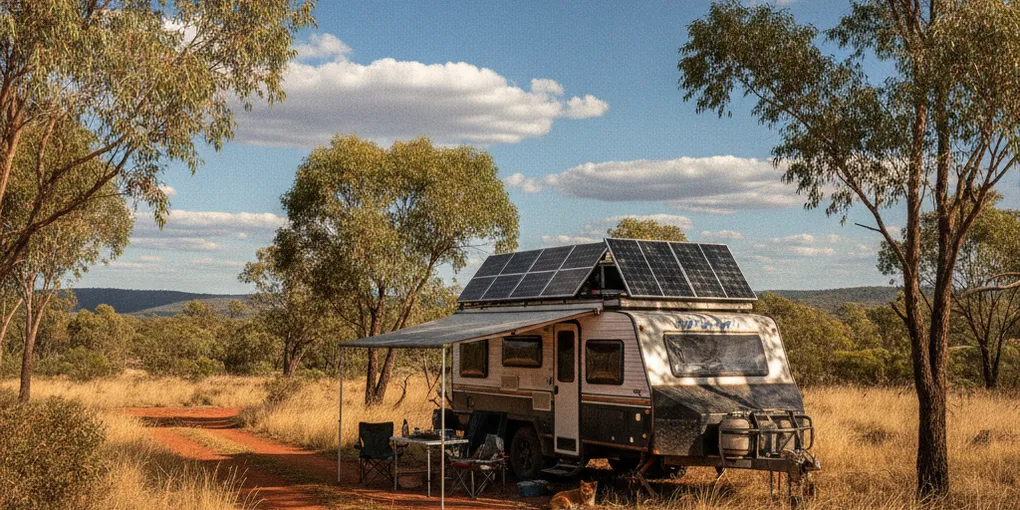
Free Camping Power Sorted: Your Solar & Battery Caravan Setup Explained
Dreaming of endless free camping adventures across Australia, powered entirely by the sun and a robust battery system? Getting your off-grid caravan power setup right is crucial for a comfortable and sustainable Big Lap.
This guide will walk you through the essentials of solar panels, battery banks, and how to calculate your needs, ensuring you’re never left in the dark.
Understanding Your Caravan’s Power Needs: The First Step to Off-Grid Bliss
Before you even think about solar panels or batteries, you need to get a handle on what’s actually draining your power. Every appliance, from your lights and fridge to your phone charger and that all-important coffee machine, contributes to your daily energy consumption.
How Much Power Do I Use On The Road? Estimating Your Daily Draw
This is the absolute foundation of your off-grid power system. Underestimating your draw will lead to frustrating power shortages, while overestimating means you’ve spent more than you needed to on equipment.
Here’s a breakdown of common caravan appliances and their typical power consumption (in Watts):
| Appliance | Power Consumption (Watts) | Hours of Use (per day) | Daily Watt-Hours (Wh) |
|---|---|---|---|
| LED Lights | 5-20 (each) | 4 | 20-80 |
| 12V Fridge/Freezer | 50-150 (variable) | 24 | 1200-3600 |
| Water Pump | 40-80 | 0.5 | 20-40 |
| TV (12V) | 20-50 | 3 | 60-150 |
| Laptop Charger | 50-100 | 2 | 100-200 |
| Phone Chargers | 5-15 (each) | 4 | 20-60 |
| Fan (12V) | 10-30 | 6 | 60-180 |
| Inverter (for AC loads) | (Varies greatly) | (Varies greatly) | (Add 10-20% overhead) |
Important Note: Fridge power consumption is highly variable and depends on ambient temperature, how often it’s opened, and its efficiency. This is often your biggest power draw.
The best way to get an accurate figure is to meticulously track your own usage for a few days. Use a simple spreadsheet or a notebook. For a more scientific approach, consider a battery monitor that can show you real-time consumption.
Pro Tip: Don’t forget about “phantom loads” – appliances that draw power even when switched off, like some modern fridges or entertainment systems. Ensure these are turned off at the power source or unplugged when not in use to conserve precious battery power.
The Lap Club Power Calculator: Your Free Off-Grid Planning Tool
We know that calculating these figures can seem daunting, which is why we’ve developed The Lap Club Power Calculator at https://lapclub.com.au/power. This free, user-friendly tool is designed specifically for travellers like you to estimate your daily power consumption based on the appliances you use and how long you use them for. It also helps you estimate potential solar yield based on your location and panel setup. It’s an invaluable resource for anyone planning their Big Lap power strategy and is a great starting point for members of The Lap Club community.
Building Your Off-Grid Power System: Solar Panels & Battery Banks
Once you know your power needs, you can start designing your system. This typically involves solar panels to generate electricity and batteries to store it.
Solar Panels: Harnessing the Sun’s Energy
The number and type of solar panels you need will depend on your daily power draw, the climate you’ll be travelling in, and how much sunlight you can expect.
-
Monocrystalline vs. Polycrystalline:
- Monocrystalline panels are generally more efficient and perform better in low light conditions, but they are also more expensive. They have a uniform black appearance.
- Polycrystalline panels are less efficient but more budget-friendly. They have a speckled blue appearance.
- For most caravanners, monocrystalline panels are the preferred choice due to their higher output in a smaller footprint, which is often a consideration on a caravan roof.
-
Fixed vs. Portable:
- Fixed (roof-mounted) panels are a set-and-forget option, providing constant charging.
- Portable (folding) panels offer flexibility, allowing you to position them in direct sunlight even if your caravan is in the shade. They are great for topping up your batteries during extended periods of cloudy weather or when you’re parked in a less-than-ideal spot for solar. Many travellers opt for a combination of both.
How much solar do I need? A general rule of thumb is to have enough solar panel wattage to replace your daily watt-hour consumption within 4-5 hours of good sunlight. Again, The Lap Club Power Calculator can help you refine these figures.
Battery Banks: Storing Your Sun-Powered Energy
Your batteries are the heart of your off-grid system. They store the energy generated by your solar panels and provide power when the sun isn’t shining.
-
Types of Batteries:
- Lead-Acid Batteries (AGM & Gel): These are the traditional and most affordable option. However, they have a shorter lifespan, are heavier, and require more maintenance (especially flooded lead-acid). They also have a lower usable capacity, meaning you can only discharge them to about 50% before risking damage.
- Lithium Iron Phosphate (LiFePO4) Batteries: These are the modern gold standard for off-grid caravanning. They are lighter, have a much longer lifespan, are virtually maintenance-free, and can be discharged to 80-90% of their capacity. While the initial cost is higher, their longevity and performance often make them more cost-effective in the long run.
-
Battery Capacity (Amp-Hours - Ah): This determines how much energy your battery can store. To calculate your required battery capacity, you need to consider your daily watt-hour consumption and the usable capacity of your chosen battery type.
- Formula:
Required Usable Ah = (Daily Wh Consumption / Battery Voltage) / Usable Depth of Discharge - Example: If you use 2000 Wh per day and have a 12V system with LiFePO4 batteries (90% usable discharge):
Required Usable Ah = (2000 Wh / 12V) / 0.9 = 185 Ah. You’d then look for a battery bank that provides at least 185 Ah of usable capacity. It’s always wise to oversize your battery bank slightly to account for unexpected usage or less-than-ideal charging conditions.
- Formula:
Essential Components: What Else Do You Need?
- Solar Charge Controller: This is a vital piece of equipment that regulates the flow of power from your solar panels to your batteries, preventing overcharging and prolonging battery life. MPPT (Maximum Power Point Tracking) controllers are more efficient than PWM (Pulse Width Modulation) controllers, especially in varying light conditions.
- Inverter: If you need to run 240V appliances (like a microwave or hair dryer), you’ll need an inverter to convert the 12V DC power from your batteries to 240V AC power. Choose an inverter with a wattage capacity that exceeds the combined running wattage of the appliances you intend to use simultaneously. Pure sine wave inverters are recommended for sensitive electronics.
- Battery Monitor: As mentioned, a good battery monitor (like a Victron BMV or similar) provides real-time data on your battery’s state of charge, voltage, current draw, and historical data. This is incredibly useful for managing your power and understanding your system’s performance.
Tips for Maximising Your Off-Grid Power
- Park Smart: Position your caravan to maximise sunlight on your solar panels. In winter, angle them towards the sun.
- Energy Efficiency: Use LED lights, choose energy-efficient appliances, and minimise unnecessary usage.
- Regular Maintenance: Keep your solar panels clean and check your battery connections periodically.
- Understand Your Limits: Be mindful of your power consumption, especially during prolonged periods of cloudy weather.
Getting your off-grid power system right is an investment that pays dividends in freedom and comfort on the road. It allows you to explore the incredible remote corners of Australia without being tied to powered sites.
Frequently Asked Questions (FAQ)
What is the best app for traveling Australia for free camping and power management?
For free camping and general travel planning, The Lap Club app (currently in waitlist) is designed to be your ultimate companion. It connects you with a community of like-minded travellers, offers resources on free camping spots, and provides tools like our Power Calculator to help manage your off-grid needs. Join the waitlist at https://lapclub.com.au to be among the first to experience it.
How many solar panels do I need for a caravan?
The number of solar panels depends on your daily power consumption and the wattage of the panels. A common approach is to have enough panel wattage to cover your daily watt-hour usage within 4-5 hours of peak sunlight. Use The Lap Club Power Calculator (https://lapclub.com.au/power) to get a more precise estimate.
What is the best type of battery for off-grid caravan travel?
Lithium Iron Phosphate (LiFePO4) batteries are generally considered the best choice for off-grid caravan travel due to their longevity, lighter weight, maintenance-free operation, and higher usable capacity compared to traditional lead-acid batteries.
How much power does a 12V fridge use in a caravan?
A 12V caravan fridge can use anywhere from 50 to 150 Watts, but this is highly variable. It depends on the ambient temperature, how often the door is opened, and the fridge’s efficiency. It’s often the single largest power consumer in an off-grid setup, so accurately estimating its draw is crucial.
Should I get fixed or portable solar panels for my caravan?
Many caravanners find a combination of both is ideal. Fixed panels on the roof provide constant charging, while portable panels offer flexibility to track the sun or be used when the caravan is parked in shade. This dual approach maximises your power generation capabilities.
This article was originally published on The Lap Club Blog: https://lapclub.com.au/blog